Nigeria’s transition toward a low-carbon economy requires a financing architecture capable of mobilizing capital at scale while maintaining fiscal and developmental balance. This article examines the evolution of green finance in Nigeria, focusing particularly on green bonds, sustainability-linked loans, and blended finance, as instruments driving the country’s energy transition. It critiques the fragmented nature of existing legal and institutional frameworks, including the Climate Change Act 2021, SEC Green Bond Rules, and Central Bank sustainability guidelines, arguing that their limited integration undermines effectiveness and investor confidence. The article contends that Nigeria’s progress depends on the creation of a coherent green finance framework that aligns fiscal policy, financial regulation, and climate targets. It concludes by proposing pathways for reform, including the development of a national green taxonomy, and the institutionalization of sustainability in public finance. By bridging policy ambition with financial innovation, Nigeria can position itself as a continental leader in green capital mobilisation and in the just transition toward a resilient, low-carbon future.
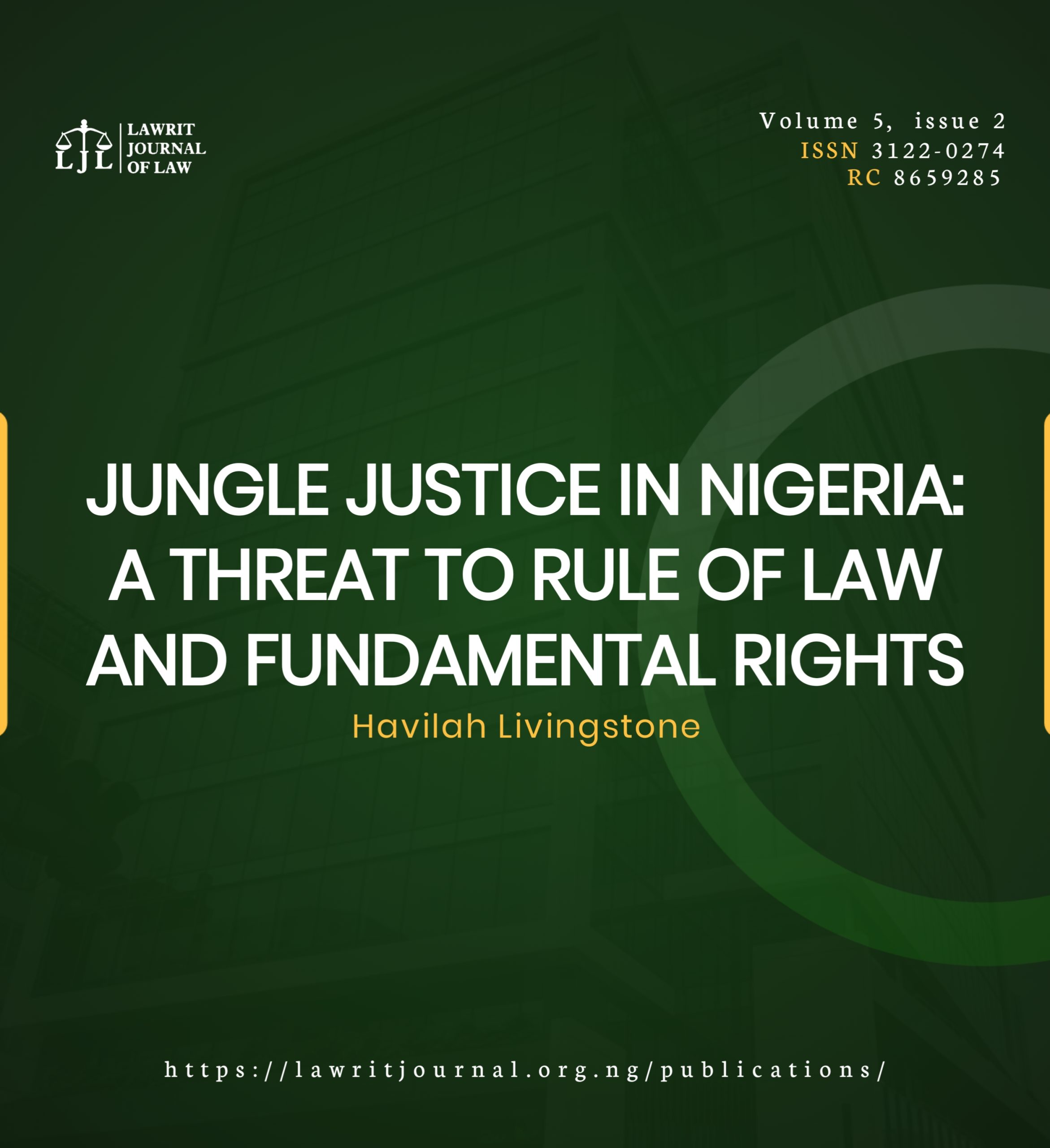
JUNGLE JUSTICE IN NIGERIA: A THREAT TO RULE OF LAW AND FUNDAMENTAL RIGHTS
Jungle justice, also known as mob justice, refers to the extrajudicial punishment of individuals suspected of crimes, often through public lynching or killings without lawful trial. In Nigeria, this practice has become a persistent plague within the justice system, reflecting both the failure of law enforcement agencies and the erosion of public trust in formal legal institutions. It violates fundamental rights enshrined in the Constitution of the Federal Republic of Nigeria, 1999, including the rights to life, fair hearing, and the dignity of the human person. Jungle justice also poses a significant threat to the rule of law. This article examines the root causes and implications of jungle justice and argues that it directly undermines the rule of law and the protection of fundamental rights in Nigeria. It concludes with practical recommendations for institutional reform, enhanced public education, and strengthened mechanisms for upholding fundamental rights.
“She Said No!”: What Nigerian Law Really Says About Rape and Consent
There are justifications put forward for offences such as murder, theft, assault or robbery, however, the offence of rape stands apart. Black’s Law Dictionary describes rape as “the unlawful carnal knowledge of a woman by a man forcibly and against her will.” This definition reflects an older legal tradition, however it opens the way for examining how Nigerian law now understands rape and how consent is interpreted. Rape remains one of the most sensitive subjects in Nigeria, as it shapes public debate, legal reforms and social attitudes. The question of what the law considers rape, and how consent is recognised or denied, forms the centre of this discussion. This article sets out to explain these issues in clear terms. It introduces the legal meaning of rape under Nigerian statutes, explores the idea of consent, and explains the circumstances that may remove or weaken the possibility of free agreement. Each part flows into the next to show how the law constructs the offence and what this means for victims, offenders and the justice system.
A Constitutional Review of the Illegitimacy of Nigeria’s Same-Sex Marriage (Prohibition) Act
Consensual sexual activity between adults of the same sex is criminalised in Nigeria. This stems from prevailing socio-cultural and religious beliefs that portray same-sex sexual relationships as unnatural, un- African, and morally reprehensible. Religious people would go further to regard it as demonic. It is on this basis that the Same Sex Marriage (Prohibition) Act (SSMPA) 2013, which criminalises various forms of same- sex unions and public display of same-sex amorous relationships, was enacted by the Nigerian government. This legislation was birthed notwithstanding that the Constitution of the Federal Republic of Nigeria, 1999 (as amended) guarantees the fundamental rights of all citizens, irrespective of one’s sexual orientation. These rights include the right to life, freedom from discrimination, right to personal liberty, right to freedom of assembly and association, right to fair hearing, and right to privacy. The study adopts a doctrinal research methodology to analyse the constitutionality of the SSMPA with regards to its alignment or otherwise with the fundamental rights enshrined in Chapter IV of the 1999 Constitution (as amended), particularly the right to privacy, right to freedom of assembly and association, and right to freedom from discrimination. The study contributes to the scholarly debate on LGBTQ+ rights and argues for the protection of the fundamental rights of every individual, regardless of gender identity and sexual oreintation.
Beyond Punishment: How Determinism Can Transform Criminal Justice and Social Responsibility
For long there has been the idea that man has free will and that he exercises this free will to make his choices. Our criminal law systems are mostly designed in a way that deals with a freely choosing person. However, there are now findings that shows that this freewill a person is assumed to have and exercise may not be as full and free as we thought. This has laid to some arguing for a more deterministic view to be included in our system which will lead to a more scientific and neutral view of those that commit crimes and one that doesn’t attach moral values. This article will be discussing the view point of determinism and how that can shape our criminal punishment system.
THE COEXISTENCE OF BUSINESS NAMES AND TRADEMARKS IN THE NIGERIAN LEGAL LANDSCAPE: WHAT IT MEANS FOR BUSINESSES AND TRADEMARK PROPRIETORS
Oftentimes, and even more so in recent times, registered business names tend to coincide or clash withregistered trademarks, blurring the line between corporate identity and proprietary rights. While theCompanies and Allied Matters Act, 2020 governs the registration of business names, the Trade MarksAct, 1967 protects distinctiveness in trade. Yet, the lack of a harmonised legal framework has allowedoverlapping registrations flourish. Adopting a doctrinal legal research methodology, this articleexplores the legal and commercial implications of the co-existence of business names and trademarksunder Nigerian law, drawing insights from recent judicial decisions. It finds that the “first-in-time”regimes adopted by both the Corporate Affairs Commission and the Trademarks Registry play apivotal role in determining which gives way, the business name or the trademark. It also finds thatalthough courts have, over time, lent preponderance to trademarks over and above business names,statutory provisions and the doctrines of passing off and prior use constitute lacunas for businessnames. Finally, it advocates practical reforms and provides actionable recommendations for businessowners to navigate the existing landscape.